Vanguard Lift Vanguard Lift

Top 10 Tips for Choosing Traction or Hydraulic Elevators?

Time:2026-05-05 Author:Amelia
0%

Choosing the right elevator for your building can be a daunting task. Many factors come into play when considering how to choose between traction and hydraulic elevators. Each type has its unique benefits and drawbacks. Traction elevators are known for their speed and efficiency, making them ideal for high-rise buildings. However, they require a machine room, which can add to construction costs. On the other hand, hydraulic elevators are often easier to install. They are well-suited for low-rise buildings, but their slower speeds might limit their appeal.

Evaluating building needs is crucial. Think about the number of floors and the expected traffic volume. Hydraulic elevators can be more cost-effective for shorter buildings. Their installation can be simpler, but they typically use more energy over time. In contrast, traction elevators offer energy savings in the long run, yet they demand more upfront investment.

Overall, it’s important to weigh the pros and cons. Consulting with experts can help clarify your choice. Understanding how to choose between traction and hydraulic elevators requires careful consideration. Reflect on specific building requirements before making a decision. Each elevator type comes with its individual set of advantages. Ultimately, the choice should align with both budget and operational needs.
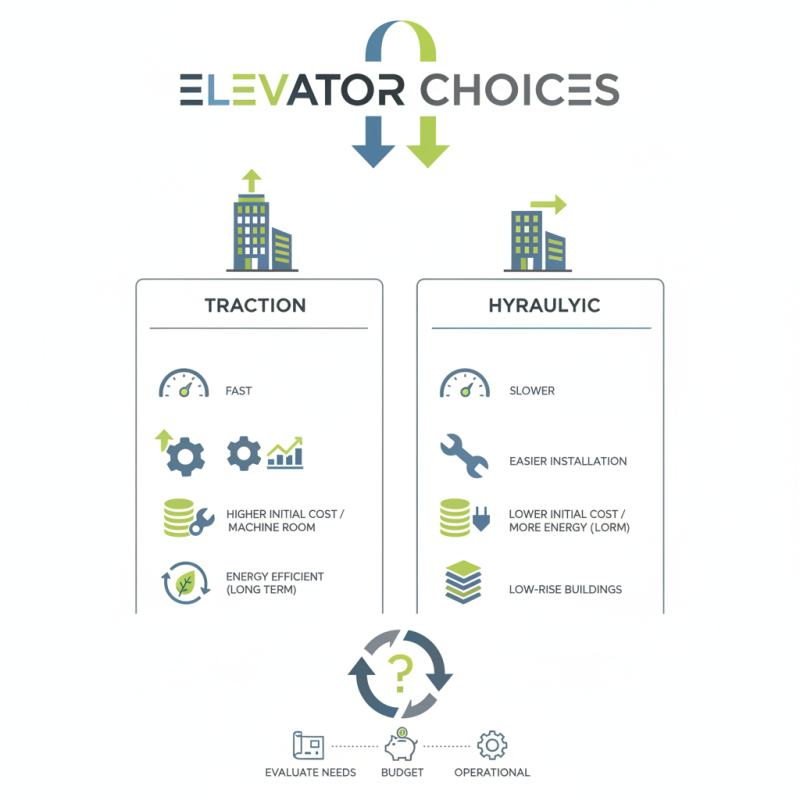
Top 10 Tips for Choosing Traction or Hydraulic Elevators?

Understanding the Basics of Traction and Hydraulic Elevators

When choosing between traction and hydraulic elevators, understanding their fundamentals is crucial. Traction elevators use cables and pulleys for movement, making them suitable for tall buildings. They are often more energy-efficient. Hydraulic elevators rely on a fluid-driven piston. They work best for shorter distances, typically up to five stories. Each system has distinct advantages and limitations.

Consider the installation space. Traction elevators often require more overhead space. They need machine rooms, which can limit design options. Hydraulic elevators, on the other hand, don't need much space above. However, they require a pit for the piston. Assessing building structure is essential in this decision-making process. Maintenance is another factor. Traction elevators may incur higher upfront costs, but they usually have lower long-term maintenance costs. Hydraulic models can face challenges with leaks over time.

Noise levels also play a role in this choice. Traction models tend to be quieter during operation. Hydraulic elevators may produce more sound due to the pump. Think about the expected load capacity as well. Traction elevators can handle heavier loads more efficiently than hydraulic ones. Investigating these details will help in making an informed decision. Reflect on your unique needs and environment.

Top 10 Tips for Choosing Traction or Hydraulic Elevators

Tip Traction Elevators Hydraulic Elevators
1. Consider Load Capacity Ideal for medium to heavy loads Suitable for lighter loads
2. Assess Building Height Effective for high-rise buildings Best for 2 to 8-story buildings
3. Evaluate Installation Space Requires a machine room Does not need a machine room
4. Look at Energy Efficiency More energy-efficient at higher speeds Generally less energy-efficient
5. Analyze Maintenance Needs Requires specialized maintenance Easier maintenance due to simple design
6. Consider Noise Levels Generally quieter during operation Can be noisier, especially during operation
7. Factor in Cost Higher initial cost Lower initial cost, but higher operational costs
8. Examine Speed Requirements Faster travel speeds available Limited speed options
9. Look at Safety Features Advanced safety systems Standard safety features
10. Evaluate Long-term Needs Better for future expansions Limited scalability

Evaluating Your Building's Specific Needs and Requirements

When selecting between traction and hydraulic elevators, understanding your building's specific needs is crucial. Each type serves different operational requirements. A traction elevator is often more energy-efficient and better for taller buildings. Conversely, hydraulic elevators work well for low-rise structures, offering smooth rides.

Consider the expected traffic in your building. High-demand environments, such as offices, may require faster solutions. Traction elevators offer speed, but they need more overhead space. Make sure to assess the available space, as this impacts installation and maintenance costs.

Evaluate future growth. If your building may expand, consider how changing needs might affect your choice. Hydraulic elevators can be easier to modify but may lack the speed and efficiency of traction options. Ultimately, reflect on these aspects thoroughly to ensure you make an informed decision.

Comparing Power Consumption and Energy Efficiency of Each Type

When comparing traction and hydraulic elevators, focusing on power consumption and energy efficiency is crucial. Traction elevators generally use a counterweight system, which results in lower energy consumption. According to the U.S. Department of Energy, traction elevators can be up to 50% more efficient than hydraulic ones, especially in mid to high-rise buildings. They consume about 3-5 kWh per 1,000 pounds of weight moved.

Hydraulic elevators, on the other hand, utilize a fluid-powered system. They may be suitable for low-rise buildings but can consume 30% more energy than traction models. A report from the American Society of Civil Engineers highlights that hydraulic systems require substantial energy to operate the pump, especially during extended use.

Tip: Assess the building's height and expected traffic flow before making a choice. In some cases, a hybrid system may be optimal. Furthermore, think about your long-term energy costs. Overwhelmingly, the initial investment for energy-efficient models can lead to substantial savings over time.

Another key point is the environmental impact. Traction elevators are often favored for their reduced carbon footprint. They can incorporate regenerative drives that recover energy, enhancing their efficiency. Make sure to discuss these factors thoroughly with a qualified elevator consultant before deciding.

Analyzing Space and Installation Considerations for Elevators

When choosing between traction and hydraulic elevators, space and installation are key factors to consider. Traction elevators require overhead machine rooms, which can impact the building's design. They also have a smaller footprint, making them suitable for high-rise buildings. In contrast, hydraulic elevators need more space for the pit and often require less headroom. This can be beneficial in low-rise buildings where space efficiency is vital.

Installation complexity varies between the two types. Traction systems may need more sophisticated electrical work during setup. Proper installation is crucial for safety and functionality. Hydraulic elevators can be simpler to install, but require adequate pit depth and space for the hydraulic cylinder. Before making a choice, evaluate your building’s layout and intended usage. You might discover limitations that affect your decision.

Many overlook the implications of elevator type on maintenance. Traction elevators generally require less frequent maintenance than hydraulic models. However, the initial costs can be different. Understanding these aspects can lead to better decision-making. Reflecting on long-term costs and operational efficiency is essential. It's important to balance initial investment against future maintenance needs.

Maintenance and Lifespan: Assessing Long-Term Costs and Benefits

When assessing long-term costs and benefits, maintenance plays a crucial role in elevator systems. Traction elevators typically require more maintenance due to their complex design and mechanical components. According to a report from the Elevator Escalator Safety Foundation, these elevators can incur maintenance costs averaging around $200 monthly. In contrast, hydraulic elevators are generally considered easier to maintain, often costing less than $150 monthly. This disparity underscores the importance of evaluating maintenance needs when selecting an elevator type.

The lifespan of each elevator type also warrants careful consideration. Traction elevators typically last 20 to 30 years with proper maintenance. Conversely, hydraulic elevators may have a shorter lifespan, averaging 15 to 20 years. A recent study by the American Society of Mechanical Engineers indicates that factors like frequency of use and the quality of maintenance can significantly impact these lifespans. For example, a well-maintained hydraulic elevator in a low-traffic building might outperform expectations, but neglect could lead to premature failure.

Investing in preventive maintenance is essential. Regular inspections can mitigate sudden breakdowns, which are costly. Building owners may find themselves spending 30% more on reactive maintenance compared to proactive upkeep. Ultimately, a long-term perspective will guide the right choice, ensuring that the elevator system remains reliable and cost-effective throughout its life.

FAQS

: What are the main differences between traction and hydraulic elevators?

: Traction elevators are better for tall buildings and are energy-efficient. Hydraulic elevators are suitable for low-rise structures.

How does expected traffic impact elevator choice?

High-traffic areas may need faster solutions. Traction elevators offer speed, but need more overhead space.

What should I consider if my building may expand in the future?

Evaluate how changing needs could affect your elevator choice. Hydraulic elevators are easier to modify but less efficient.

How do traction and hydraulic elevators compare in energy efficiency?

Traction elevators use less energy and can be 50% more efficient than hydraulic models, especially in taller buildings.

What are the installation considerations for each type of elevator?

Traction elevators need overhead machine rooms and are complex to install. Hydraulic elevators require adequate pit space.

Is long-term maintenance different for these elevator types?

Yes, traction elevators generally need less frequent maintenance, while hydraulic ones may incur higher operational costs over time.

Can I use a hybrid elevator system?

Yes, in some cases, a hybrid system offers the best of both worlds regarding efficiency and operational needs.

Why is environmental impact important in elevator selection?

Traction elevators have a smaller carbon footprint and can use regenerative drives to enhance efficiency.

How does building layout affect elevator choice?

Space considerations can limit options. Traction elevators need smaller footprints, while hydraulic elevators require more pit depth.

Are initial costs the only factor to consider in elevator selection?

No, think about long-term energy costs and maintenance needs. Balancing initial investment with future expenses is essential.

Conclusion

When considering how to choose between traction and hydraulic elevators, it's essential to understand their fundamental differences and how they align with your building's specific needs. Traction elevators rely on a pulley system and are typically more energy-efficient, making them suitable for taller buildings. On the other hand, hydraulic elevators use a pumping system and are often preferred for low-rise buildings due to their simpler installation and lower initial costs.

Evaluating power consumption, energy efficiency, space requirements, and installation considerations are crucial for making an informed decision. Additionally, assessing long-term maintenance and lifespan costs will provide insights into the overall benefits and drawbacks of each type of elevator. By carefully weighing these factors, you can select the elevator system that best meets your operational requirements and budget.

Amelia

Amelia

Amelia is a seasoned marketing professional with a wealth of expertise in our company’s core offerings. With an unwavering passion for driving growth and innovation, she plays a pivotal role in shaping our marketing strategies and enhancing brand visibility. A key aspect of her responsibilities......